LLM Gateway
Every model in the lab is reachable through one OpenAI-compatible endpoint: a central LiteLLM proxy that owns all provider credentials and exposes 60+ model aliases to every harness and agent.
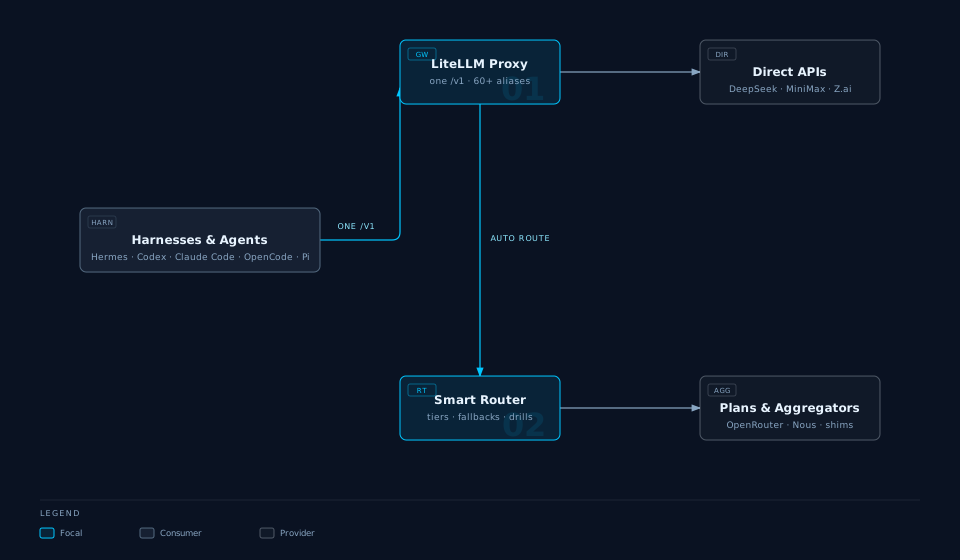
What the gateway buys you
- One key, one endpoint, one wire format. A harness that speaks the OpenAI API can use any model in the lab — DeepSeek, GLM, MiniMax, Kimi, GPT, Claude, Gemini, Qwen, Grok — without changing code.
- Provider credentials never reach consumers. Harnesses and gateways use virtual keys; the master key and upstream keys live only in the proxy.
- Aliases are policy. A consumer asks for
chat-smart; the proxy decides which provider and which account serve it, and can change that decision without touching the consumer. - Cost control. The cheapest tier that answers is the default; paid providers are explicit opt-ins or last-resort fallbacks; budgets are enforced per tenant.
- Failover is continuous. Weighted multi-key tier groups, provider fallback chains, and permanent failover-drill aliases keep the routing plane proven under real failure conditions.
The alias tiers
Four stable tiers cover nearly every workload — the same four names every harness exposes:
| Alias | Use when | Backing (current policy) |
|---|---|---|
chat-fast |
Cheap, fast, no reasoning — mechanical edits | DeepSeek V4 Flash (direct) |
chat-balanced |
Middle ground — 1M ctx, function calling | DeepSeek V4 Flash (direct) |
chat-smart |
Default — 1M ctx, function calling | GLM-5.2 (coding plan) |
research-deep |
Deep reasoning, long turns | GLM-5.2 (coding plan) |
smart-router |
Automatic: let the router pick | Auto Router v2 (see Smart router) |
Coding-specific tiers (code-fast, code-smart) and special-purpose aliases
(vision, embeddings, canaries) complete the catalog.
Reliability engineering
- Permanent failover drills:
canary-*aliases force a real upstream rate-limit error on every call and must be served by the mirror route — the fallback machinery is exercised in production continuously, not only during incidents. - Continuity routes: every subscription-backed tier has a pay-as-you-go mirror (e.g., OpenRouter) so a plan outage degrades to a slightly more expensive provider instead of a dead endpoint.
- Weighted tier groups: multiple upstream accounts/keys behind one alias with weights for capacity scaling — with commented "capacity slots" ready to activate.
Note
Names of current backings are descriptive of the routing policy; the routing plane is designed so backings can change without consumer changes.